The Story
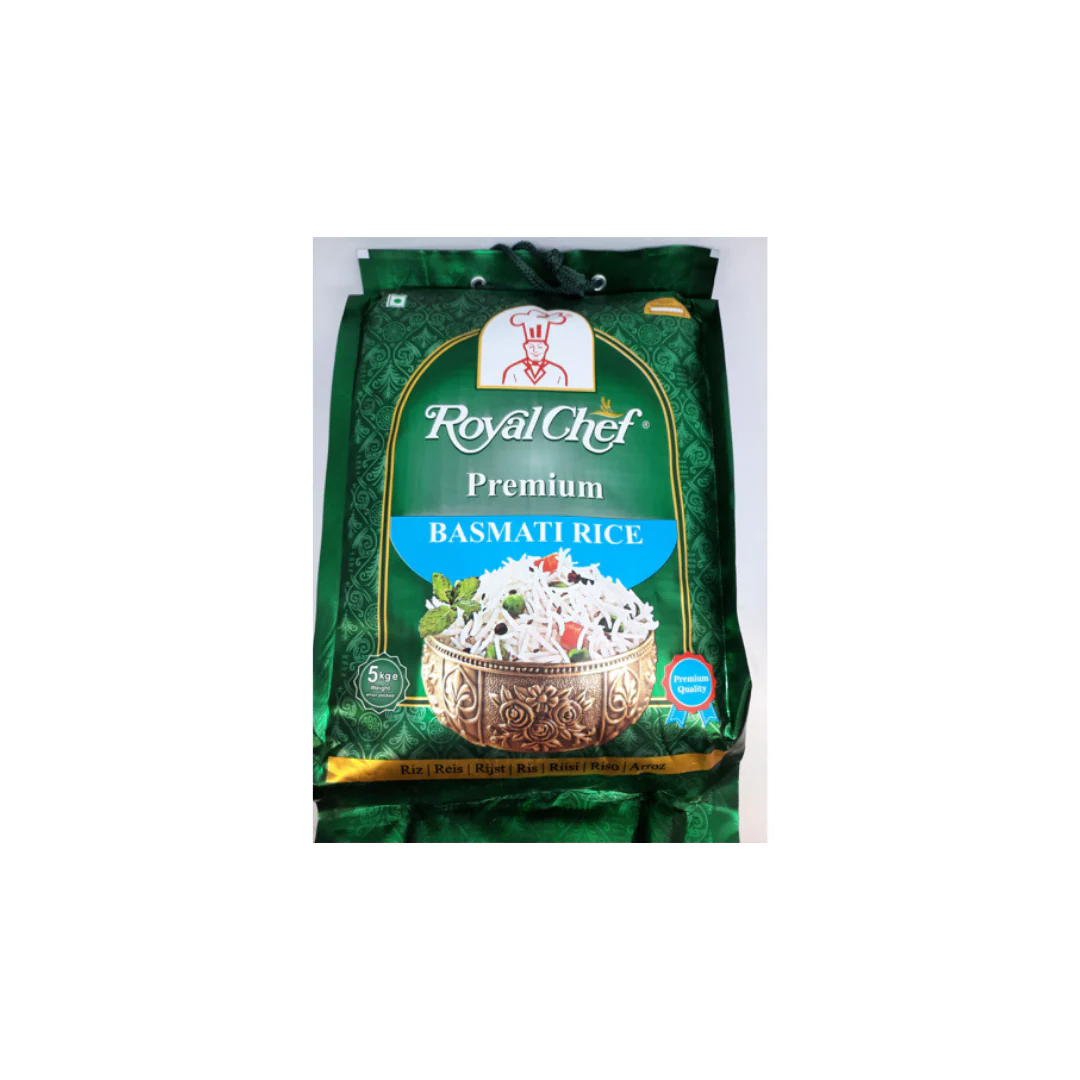
Buy Royal Chef Basmati (GREEN) 5kg Online with London Grocery
Basmati rice is a long-grain rice with a subtle nutty flavor that originated in the Indian subcontinent and is now widely consumed. It is usually served with Indian food, and it is perfect for dipping into thick, spice-infused curries.
-
Why is basmati green?
Rice kernels with chlorophyll come from the bottom of a stalk, where they mature more slowly than kernels at the top; the green color indicates the presence of natural chlorophyll, a desirable nutrient; rice kernels with chlorophyll come from the bottom of a stalk, where they mature more slowly than kernels at the top.
-
What to serve with basmati rice?
It is perfect for a delicious biryani, jeera rice and pualo.
-
What makes basmati rice special?
The Basmati grain is special in that when cooked, it swells to more than twice its dry length. The grains only expand lengthwise, unlike other forms of rice, allowing them to keep their characteristic length and slenderness when cooked.
-
What is the difference between white rice and basmati rice?
Basmati rice is a white rice variety. It has a slightly nutty fragrance and is more aromatic than plain white rice (such as rice used in Chinese and Japanese cuisine). In addition, the grains are longer than those of typical white rice.
-
Which rice is the healthier one?
Basmati rice, in its whole-grain form, can be incorporated into any balanced diet. Although they have nearly identical calorie counts, basmati rice has a lower glycemic index (GI), which makes it a better choice for losing belly fat or maintaining a healthy weight. Basmati rice has a GI of 52, while white rice has a GI of 79. Furthermore, basmati rice is gluten-free and low - saturated. It provides all eight essential amino acids, as well as folic acid, and contains low sodium and cholesterol-free.
-
How to cook basmati rice?
To make basmati rice, follow these steps:
- In a saucepan, combine the water and rice
- Bring to a low simmer without the lid on medium high
- Place cover on pot when entire surface is bubbling and foamy, reduce heat to medium low, and simmer for 12 minutes
- Turn off the heat and set aside for 10 minutes.
- After that, fluff
- And serve!
- Basmati rice ratio
1: 1.5 is the correct rice-to-water ratio (1 cup of rice to 1.5 cups of water). Most people use 1 3/4 to 2 cups of water, plus they rinse the rice, which causes it to become soggy and exacerbates the mushy rice problem.
Description
Buy Royal Chef Basmati (GREEN) 5kg Online with London Grocery
Basmati rice is a long-grain rice with a subtle nutty flavor that originated in the Indian subcontinent and is now widely consumed. It is usually served with Indian food, and it is perfect for dipping into thick, spice-infused curries.
-
Why is basmati green?
Rice kernels with chlorophyll come from the bottom of a stalk, where they mature more slowly than kernels at the top; the green color indicates the presence of natural chlorophyll, a desirable nutrient; rice kernels with chlorophyll come from the bottom of a stalk, where they mature more slowly than kernels at the top.
-
What to serve with basmati rice?
It is perfect for a delicious biryani, jeera rice and pualo.
-
What makes basmati rice special?
The Basmati grain is special in that when cooked, it swells to more than twice its dry length. The grains only expand lengthwise, unlike other forms of rice, allowing them to keep their characteristic length and slenderness when cooked.
-
What is the difference between white rice and basmati rice?
Basmati rice is a white rice variety. It has a slightly nutty fragrance and is more aromatic than plain white rice (such as rice used in Chinese and Japanese cuisine). In addition, the grains are longer than those of typical white rice.
-
Which rice is the healthier one?
Basmati rice, in its whole-grain form, can be incorporated into any balanced diet. Although they have nearly identical calorie counts, basmati rice has a lower glycemic index (GI), which makes it a better choice for losing belly fat or maintaining a healthy weight. Basmati rice has a GI of 52, while white rice has a GI of 79. Furthermore, basmati rice is gluten-free and low - saturated. It provides all eight essential amino acids, as well as folic acid, and contains low sodium and cholesterol-free.
-
How to cook basmati rice?
To make basmati rice, follow these steps:
- In a saucepan, combine the water and rice
- Bring to a low simmer without the lid on medium high
- Place cover on pot when entire surface is bubbling and foamy, reduce heat to medium low, and simmer for 12 minutes
- Turn off the heat and set aside for 10 minutes.
- After that, fluff
- And serve!
- Basmati rice ratio
1: 1.5 is the correct rice-to-water ratio (1 cup of rice to 1.5 cups of water). Most people use 1 3/4 to 2 cups of water, plus they rinse the rice, which causes it to become soggy and exacerbates the mushy rice problem.